icon.
icon. 
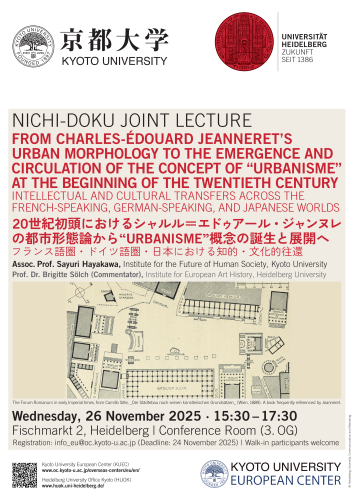
Marking the 25th Nichi-Doku Joint LectureThe 25th Nichi-Doku Joint Lecture Series took place in Heidelberg. Assistant Professor Sayuri Hayakawa from Kyoto University’s Institute for the Future of Human Society delivered a thought-provoking lecture titled “From Charles-Édouard Jeanneret’s Urban Morphology to the Emergence and Circulation of the Concept of ‘Urbanisme’ at the Beginning of the Twentieth Century: Intellectual and Cultural Transfers across the French-speaking, German-speaking, and Japanese Worlds.” She offered a fresh perspective on the early work of one of Charles-Édouard Jeanneret (later called Le Corbusier), one of modernism’s most influential figures. The lecture, which explored the organic and regionalist roots of Le Corbusier’s urban thought, dove deep into art and intellectual history, and highlighted the relevance of his methodology for the cities we live in today. |
 |
The Lecture
Assistant Professor Hayakawa’s initial part of the lecture focused on Jeanneret’s early, lesser-known approach to urban form—one that was organic, regionalist, and deeply influenced by both French and German intellectual traditions. It centered on Jeanneret’s unfinished manuscript, La Construction des villes, analyzing his typological studies of urban elements such as blocks, streets, and squares. Assistant Professor Hayakawa highlighted how Jeanneret’s perceptual and corporeal logic of urban form emerged from a synthesis of these traditions, offering a nuanced understanding of his early work.
The second part of the lecture traced the evolution of the French concept of urbanisme, which emerged as a new disciplinary and theoretical framework in the early 20th century. Assistant Professor Hayakawa outlined her research, which examines how this concept was received and reinterpreted in Japan, contrasting it with the technically oriented Japanese notion of 都市計画 (town planning), which has often been linked to British and German influences.
By repositioning Jeanneret’s thought and methodology as a bridge between form and ideology, the lecture provided a multilayered perspective on the formation of modern urban thought, emphasizing the cross-cultural exchanges that shaped it.
 |
 |
|
| Welcome address by Chiyoko Kanno (KUEC) | Lecture by Professor Hayakawa |
Professor Brigitte Sölch from Heidelberg University Institute for European Art History provided insightful commentary, underscoring the importance of . She commended Assistant Professor Hayakawa’s analysis for illuminating the that shaped the global spread of urbanism. Professor Sölch further emphasized the value of examining these methodologies to , deepening our understanding of the .
 |
||
| Professor Sölch discussing the lecture with Professor Hayakawa |
The Audience
The lecture concluded with a lively Q&A session, where participants discussed the implications of , as well as the . The dialogue also explored how these urban landscapes reflect and are shaped by
Further Information
- Program of the 25th Nichi-Doku Joint Lecture
- The Nichi-Doku Joint Lecture Series